
Here’s the truth nobody talks about: the most dangerous budget you’ll ever make is the perfectly detailed, color-coded, 47-category spreadsheet that takes you three hours to build and exactly eight days to abandon.
I know because I’ve seen it happen — including to myself. A few years ago, I sat down and built what I thought was the ultimate budget. I had categories for “dining out weekdays,” “dining out weekends,” “coffee — at home,” “coffee — at work,” “gifts — planned,” “gifts — spontaneous”… You get the picture. It was a work of art. It was also completely useless after the third week of February.
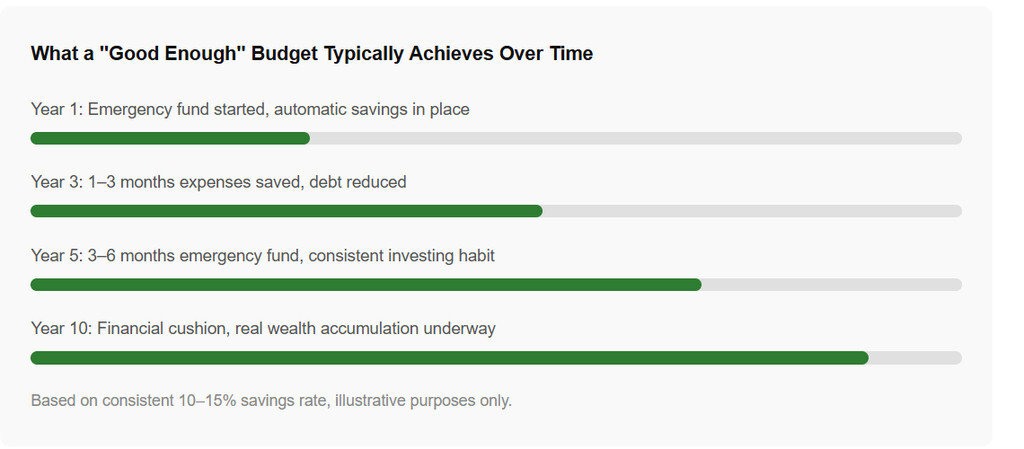
A good enough budget isn’t a compromise or a cop-out. It’s actually the smarter strategy — and the research backs this up. The goal of a personal budget isn’t to track every dollar with military precision. It’s to put your money in the right general direction and make that direction sustainable for the next five, ten, twenty years. Perfection makes that impossible.

Sound familiar? The more complicated the budget, the faster most people quit it.
Why Does Budget Perfectionism Feel So Right?
There’s a reason so many of us fall into the perfectionism trap. Budgeting carries real emotional stakes — it’s tied to security, freedom, and the fear of making mistakes with money. So we compensate. If we can just build a perfect enough system, the theory goes, we’ll be safe. We’ll finally be “good with money.”
The problem is that our brains are wired to find planning satisfying in a way that feels suspiciously like action. Research from Columbia Business School has shown that goal-setting itself triggers a reward response — which means the act of building your elaborate budget gives you the same dopamine hit as actually sticking to one. And then real life shows up: your car needs brakes, your kid gets a field trip you forgot about, or you just have a bad week and order pizza three times in a row. One deviation from the “perfect” plan and the whole system feels broken. Many people quit entirely — not because they lack discipline, but because perfection set up an impossible standard from the start.
The psychological term for this is all-or-nothing thinking, and it’s one of the most common ways people undermine their own financial progress. The fixed-budget mindset says: “I went $40 over on groceries this month, so the whole budget is ruined.” The good-enough mindset says: “I went $40 over on groceries — no big deal, I’ll just pull it from next month’s buffer.”
What a Good Enough Budget Actually Looks Like
A good enough budget isn’t formless. It has structure — just not rigid structure. Think of it less like a floor plan with every wall measured and more like a compass that keeps you pointed in the right direction even when the terrain is messy.

Simple on purpose — not because you gave up, but because you got smart about what actually works.
The 3-Bucket System
The most durable simple budget I’ve encountered — and the one I’ve seen people actually stick to — collapses everything into three buckets:
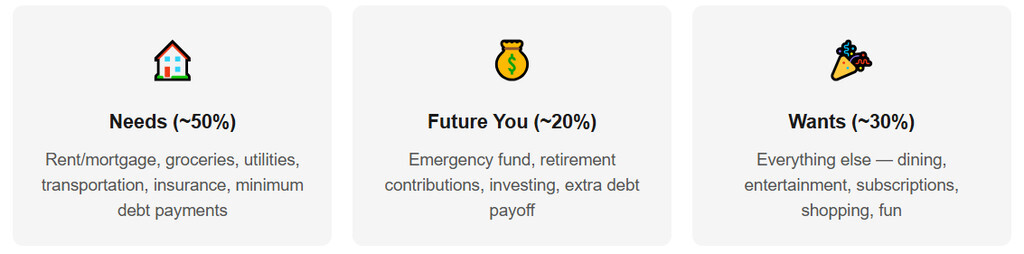
That’s it. You probably recognize this as the 50/30/20 rule, which Senator Elizabeth Warren popularized in her book “All Your Worth” back in 2005. It’s been over two decades and it still works — not because it’s perfectly calibrated for everyone’s life, but because it’s clear enough to use.
The percentages aren’t sacred. If you live in a high-cost city, your needs bucket might be 60% and your wants bucket might be 15%. That’s fine. The point is that you have a simple framework that tells you when something is off-track — when your needs creep past 70%, or when you’re not putting anything into Future You, you know it’s time to adjust. That clarity is enough. You don’t need 47 sub-categories for that clarity.
⚡ Key Insight
A budget you follow 80% of the time will build more wealth over 10 years than a perfect budget you quit after 6 weeks. Consistency is the multiplier — not precision.
How Good Enough Budgets Actually Build Wealth Faster
Let’s look at what actually happens over time. Imagine two people, both earning $65,000 a year.
Alex builds a perfect budget every January — detailed, meticulously categorized. Alex tracks every dollar for 6–8 weeks, then life happens, the system gets messy, and it gets abandoned until next January. Over 10 years, Alex consistently saves about 3–5% of income because of repeated restarts and gaps.
Jordan has a simple good enough budget — automates $650/month (10% of income) into savings, spends the rest without obsessing, and checks the balance quarterly to make sure nothing is out of control. Jordan never “tracks” a budget in the traditional sense. Over 10 years at a modest 7% average annual return, those automated savings grow to roughly $113,000.
Alex’s technically “better” budget, followed inconsistently, might produce $30,000–$40,000 over the same period. Jordan’s “imperfect” system wins — not because of financial sophistication, but because of something far more powerful: it kept running.
This is the core logic behind automation-first personal finance, something I’ve written about in detail in my post on automating your savings before you can spend it. The system does the work so you don’t have to rely on willpower every month.

Managing money together gets a lot easier when the system doesn’t require both people to be budget nerds.
Where Budget Perfectionism Quietly Costs You Money
Beyond just quitting, perfectionism introduces a few specific failure modes worth recognizing:
Paralysis at the Start
Spending three weeks researching the “right” budgeting app instead of just starting with a piece of paper and a pen. I’ve talked to people who spent more time comparing YNAB, Mint, Copilot, and spreadsheet templates than they ever spent actually budgeting. Meanwhile, the month goes by with no system at all. Starting imperfectly is always better than not starting.
The “Fresh Start Monday” Trap
When this month’s budget falls apart, many perfectionists resolve to start fresh next month — with an even better system. Then the next month’s system collapses too. They’re perpetually one reset away from “really starting.” This cycle can eat years. The good-enough alternative is to just keep going with a slightly bent system rather than throwing it out.
Over-Categorization Fatigue
Research on decision fatigue shows that making many small decisions throughout the day depletes the same mental resources you need for other tasks. A budget with 30 categories forces you to make categorization decisions constantly — which is exhausting and makes you more likely to give up. Three buckets? That’s three decisions per purchase. Sustainable.
If you’ve ever felt the shame spiral after overspending in one category — what researchers call the “what-the-hell effect” in behavioral economics — you know exactly what I mean. One bad week becomes a justification to throw out the whole system. A good enough budget has built-in flexibility that short-circuits that spiral before it starts. For a deeper look at how the psychology of money shapes these patterns, this piece on money mindset is worth the read.
Building Your Own Good Enough Budget in 20 Minutes
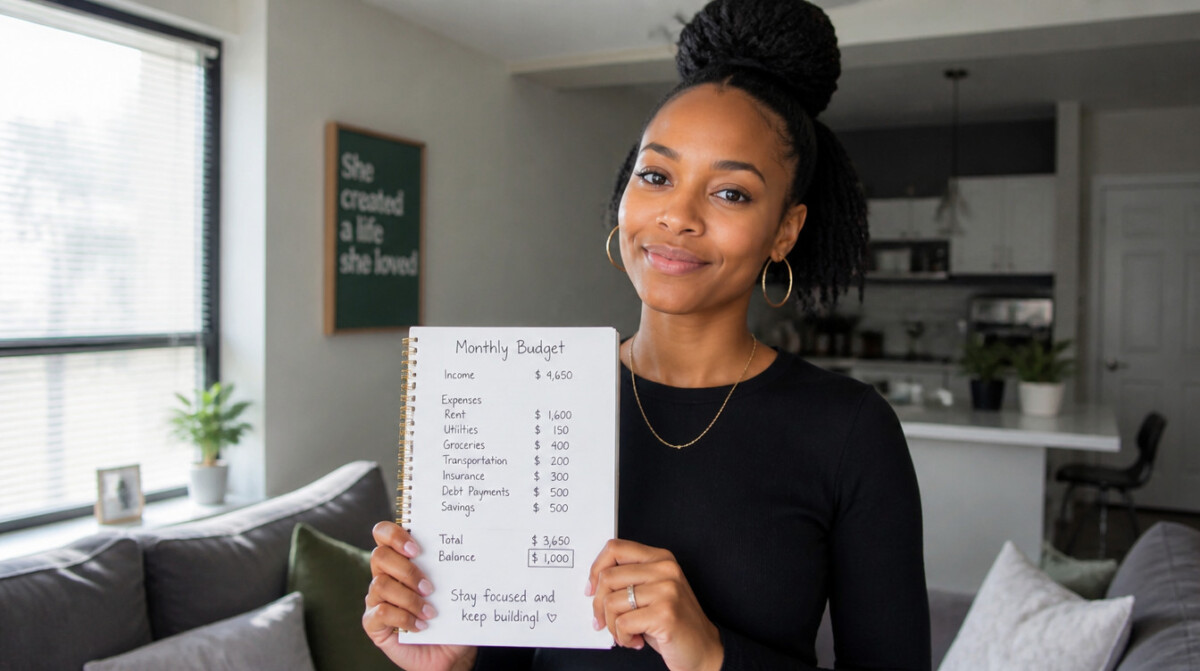
Here’s the honest version of how to set one up — no app required:
- Write down your monthly take-home income. Not gross, not salary — what hits your bank account each month after taxes.
- List your non-negotiable fixed costs. Rent/mortgage, car payment, loan minimums, subscriptions you’d never cancel. Add them up. This is your “Needs floor.”
- Set a savings transfer. Even $100/month is a start. Ideally aim for 10–20% of take-home. Automate it to happen the day after payday so it’s gone before you can spend it.
- Everything left is your spending pool. You don’t need to allocate it further unless something feels off. Just spend it, check in monthly, and adjust if the pool runs out before the month ends.
- Do a 10-minute monthly check-in. Look at one number: did you save what you planned? If yes, you’re on track. If no, why — and is it a one-time thing or a pattern?
The monthly check-in is the only real “maintenance” this system needs. No weekly logging, no receipt scanning, no guilt about the Wednesday burrito. Just one number, once a month.
Financial confidence doesn’t come from a perfect spreadsheet. It comes from a system you actually keep up with.
When Should You Actually Add More Detail to Your Budget?
I want to be fair here: more detailed budgeting does have a place. If you’re actively paying down high-interest debt and need to squeeze every available dollar toward that payoff, a closer look at your spending categories can accelerate your timeline significantly. If you’re planning a major purchase — a house, a car, a wedding — a temporary 3-month deep-dive into your finances to free up cash makes sense.
The key word is temporary. Treat intensive budgeting like a sprint, not a marathon. Use it purposefully when you have a specific goal, then step back to the simple system when that sprint is over. The people who try to maintain sprint-level intensity as a permanent lifestyle are the ones who burn out and quit budgeting entirely.
For anyone specifically working on debt payoff alongside their savings strategy, the overlap between budgeting and debt prioritization is something I covered in the post on paying off debt while building savings — both are possible, and the approach matters.
💡 Quick Reality Check
Ask yourself: Is my current budget something I could still be doing one year from now? If the honest answer is “probably not,” simplify it until the answer is “yes.” Sustainability beats sophistication every single time.
The Financial Progress You’re Actually Looking For
Here’s what I’ve noticed after reading and thinking a lot about personal finance: the people who build real wealth over time are almost never the ones with the most sophisticated systems. They’re the ones who set up something simple, automated the most important parts, and got out of their own way.
The good enough budget is really a philosophy as much as it is a technique. It says: I’m going to prioritize progress over perfection. I’m going to keep moving forward even when I make mistakes. I’m going to trust the direction more than the destination.
That’s not settling. That’s strategy.
Frequently Asked Questions About the Good Enough Budget
What is a good enough budget?
A good enough budget is a simple, flexible spending plan that gives you general direction without demanding exact-to-the-dollar tracking. It prioritizes consistency over precision — typically using broad categories and rough targets rather than detailed line items. The goal is a system you’ll actually maintain for years, not one that’s theoretically optimal but too demanding to keep up.
Why do perfect budgets fail?
Perfect budgets fail because they create unrealistic expectations, take too much time to maintain, and collapse completely the moment one unexpected expense appears. The all-or-nothing mindset makes people quit budgeting entirely rather than adjusting. When the plan requires perfection to feel “valid,” any deviation becomes a reason to quit — instead of a normal part of managing money in the real world.
How many budget categories do I actually need?
Most people do well with just 3–5 broad categories: needs (housing, food, transportation), savings/investing, and discretionary spending. More categories add friction without adding real financial benefit. A simpler structure is easier to check in on, easier to maintain, and less likely to trigger the decision fatigue that makes people abandon budgets altogether.
Is the 50/30/20 rule a good enough approach to budgeting?
Yes — the 50/30/20 rule (50% needs, 30% wants, 20% savings) is an excellent good enough framework for most people. It’s not perfect for every income level or city, but it gives clear directional guidance and is easy to maintain long-term. The percentages can flex based on your situation — the important thing is using them as guardrails, not hard rules.

Disclosure: This post may contain affiliate links. If you purchase through them, we may earn a small commission at no extra cost to you. We only recommend resources we genuinely find useful. The examples and projections in this post are illustrative and do not constitute financial advice. Please consult a qualified financial professional for advice tailored to your situation.