
How Much Should You Have in an Emergency Fund? (The Honest Answer)

If you are wondering how much should you have in an emergency fund, you have probably seen the standard answer: three to six months of expenses. That’s not wrong, but it’s not really an answer either — it’s a range so wide it covers everyone from a debt-free remote worker with a working spouse to a single-income freelancer with no safety net. Your real emergency fund number is your essential monthly expenses multiplied by a factor based on how stable your income actually is — usually landing somewhere between $3,000 and $30,000 depending on your situation. The formula below walks you through finding your exact number in about ten minutes.
Why “Save 3 to 6 Months” Isn’t the Full Answer
I used to repeat the 3-to-6-months rule to anyone who asked, because it’s easy to say and technically defensible. Then a friend who freelances in graphic design told me she’d saved four months of expenses, felt “on track” according to every article she’d read, and still had a full-blown panic attack when a client disappeared for two months without paying an invoice. Four months of her expenses covered exactly six weeks of her actual runway, because her income was irregular in a way the generic rule never accounted for.
That’s the problem with a single range applied to everyone. A salaried person with dual income and no dependents is in a fundamentally different risk position than a commission-based sales rep supporting a family alone. The 3-6 month range isn’t wrong — it’s just an average smeared across situations that don’t have much in common. What actually determines your number isn’t a rule of thumb; it’s a combination of how predictable your income is, how many people depend on it, and how fast you could realistically replace it if it stopped.
The 3-Step Formula to Find Your Actual Number
Instead of picking a number out of the range and hoping it fits, work through these three steps in order. Grab a notebook, a bank statement from the last two months, or a simple spreadsheet — whichever you’d actually use.
Step 1: Add Up Your Essential Monthly Expenses (Not Your Total Spending)
Your emergency fund only needs to cover what keeps the lights on, not your full lifestyle. Go through last month’s spending and separate it into two piles:
- Essential: rent or mortgage, utilities, groceries, minimum debt payments, insurance, medications, transportation to work, childcare if you need it to work
- Non-essential: subscriptions, dining out, entertainment, shopping, travel
Add up only the essential column. For most households this lands somewhere between 60-75% of total monthly spending. If your total spending is $4,000/month, your essential number might be closer to $2,600-$3,000. That essential figure — not your full budget — is the base number the rest of this formula uses.
Step 2: Choose Your Risk Multiplier Based on Income Stability
This is the step the generic advice skips. Instead of guessing between 3 and 6, match your actual situation to the row below:
| Your situation | Recommended months | Why |
|---|---|---|
| Salaried, dual-income household, stable industry | 3 months | A second income cushions the gap while you find new work |
| Salaried, single income, stable industry | 4-5 months | Full household depends on one paycheck |
| Freelance, commission-based, or gig income | 6-9 months | Income is naturally irregular even without a crisis |
| Recent job change, probation period, or unstable industry | 6-8 months | Higher near-term layoff/income-gap risk |
| Self-employed with business debt or few clients | 9-12 months | A single lost client can mean a real income gap |
If you’re between categories, round up rather than down. Underestimating this number is the more common mistake — most people who build an emergency fund and still feel anxious during a real emergency picked a multiplier that matched their optimism, not their actual risk.
Step 3: Multiply and Set a Milestone, Not Just a Final Number
Multiply your Step 1 essential expenses by your Step 2 multiplier. If your essential expenses are $2,800/month and you’re a single-income freelancer (7-month multiplier), your target is $19,600. That number can feel discouraging staring at a $400 checking account balance, so don’t start there.
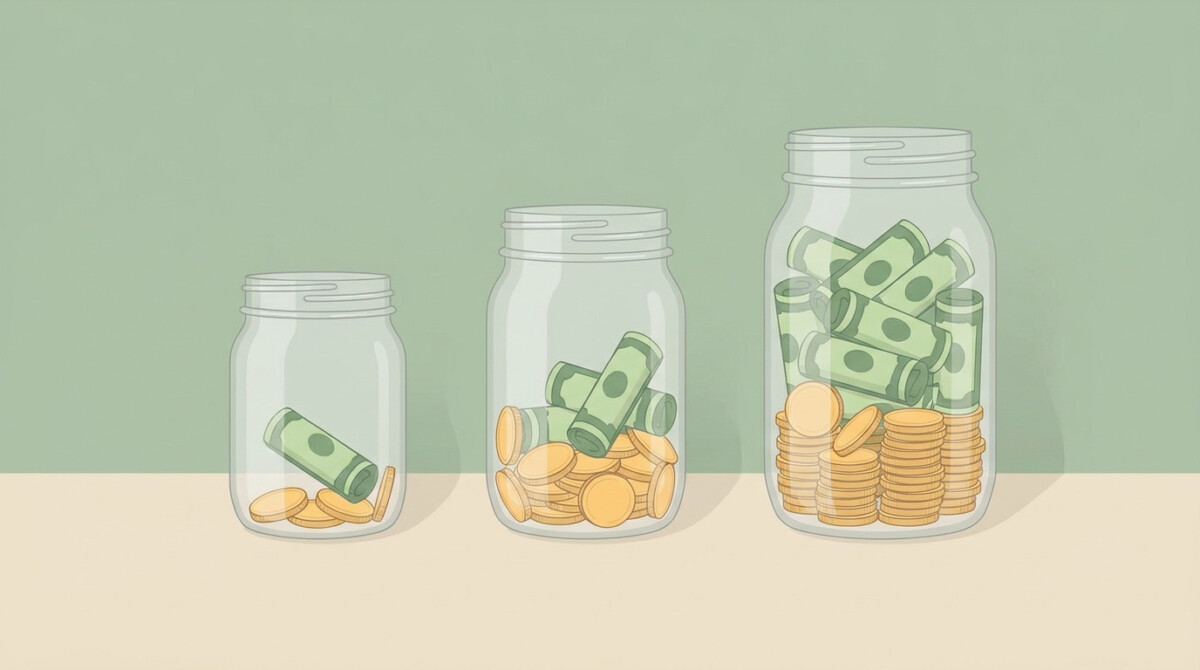
Set an interim milestone first: $1,000, or one month of essential expenses, whichever is smaller. That first milestone is what actually stops most financial emergencies — a car repair, a broken appliance, an unexpected copay — from turning into new credit card debt. Build to your full number in stages after that: one month, then three, then your final target.
Where to Actually Keep This Money
An emergency fund that’s hard to reach defeats its own purpose, but one that’s too easy to reach gets spent on things that aren’t emergencies. The middle ground most people land on is a high-yield savings account (HYSA) at a different bank than your everyday checking account — accessible within a day or two, but with just enough friction that you won’t tap it for a sale at your favorite store. As of writing, top HYSAs are paying meaningfully more than traditional savings accounts, though rates shift often enough that it’s worth checking Bankrate’s current HYSA comparison before opening one, rather than trusting any number printed here.
Keep it separate from your checking account and, if your bank allows it, name the account something specific like “Emergency Fund — Do Not Touch.” That small psychological barrier matters more than people expect.

What Actually Counts as an Emergency
A surprisingly common way emergency funds fail isn’t under-saving — it’s scope creep on what counts as “an emergency.” A few boundaries worth setting for yourself before you’re standing in a store making the decision in the moment:
- Counts: job loss, medical bills, essential car or home repairs, unavoidable travel for a family emergency
- Doesn’t count: a sale on something you wanted anyway, a vacation, a gift, a “good deal” that expires today
If you’re not sure whether something qualifies, a useful test is asking whether you’d have to go into debt to cover it if the emergency fund didn’t exist. If the honest answer is no, it’s probably not what this money is for.
A Mistake Worth Naming

The mistake I made the first time I tried this wasn’t undersaving — it was treating my emergency fund and my “fun money” savings as the same pot. I’d hit my target, feel good about it, and then quietly dip into it for something that felt urgent but wasn’t. Six months later the balance had crept back down to almost nothing, and I had no idea where it went, because there was no line I’d drawn for myself. Separating the account, naming it clearly, and deciding in advance what counts as an emergency fixed that faster than any spreadsheet did.
Frequently Asked Questions
Is 3 months of expenses enough for an emergency fund?
For a salaried worker in a stable job with a second household income, 3 months is often enough. For single-income households, freelancers, or anyone in an unstable job situation, 6 months or more is safer — use the risk multiplier table above to match your specific situation rather than defaulting to the low end of the range.
Should I pay off debt or build an emergency fund first?
Most financial educators recommend a small starter emergency fund (around $1,000) before aggressively paying down debt, then splitting focus between debt payoff and building the fund the rest of the way. This prevents a new emergency from becoming new high-interest debt while you’re still paying off old debt.
Where should I NOT keep my emergency fund?
Avoid keeping it in the stock market, cryptocurrency, or any investment that can lose value right when you need the money most. Also avoid keeping it in your everyday checking account, where it’s too easy to accidentally spend down without noticing.
How long does it realistically take to build an emergency fund?
This varies widely based on income and expenses, but starting with the $1,000 milestone from Step 3 above and automating a fixed transfer every payday (even $50-100) is far more reliable than trying to save “whatever’s left over” at the end of the month.
Do I need a full emergency fund before I start investing?
Most financial educators recommend having at least your starter emergency fund ($1,000, or one month of expenses) in place before investing, so a market downturn and a personal emergency don’t hit you at the same time. This is general education, not individual financial advice — consider your full financial picture or talk to a financial professional for guidance specific to your situation.
Keep Building From Here
An emergency fund is one piece of a full budgeting foundation — it works best alongside a clear monthly budget and a plan for irregular expenses. A few related guides worth reading next:
- How to Build a Budget from Scratch (Beginner’s Guide)
- The 50/30/20 Budget Rule Explained
- Zero-Based Budgeting: A Step-by-Step Guide
- How to Build a Sinking Fund for Irregular Expenses
This article is for general educational purposes and isn’t personalized financial advice. Your situation may call for a different approach — a financial advisor can help you apply these ideas to your specific numbers.