
To build a budget from scratch, you need four things: your real monthly take-home income, a list of your actual expenses from the last 60–90 days (not your guesses), a set of spending categories that match how you actually live, and a simple rule for deciding where every leftover dollar goes. That’s it. No app required, no finance degree, no color-coded spreadsheet — although you can add those later if they help.
If that sounds too simple, good. The reason most budgets fail isn’t that they’re too simple. It’s that they’re built on wishful numbers instead of real ones.
I know this because my first budget lasted exactly eleven days. I wrote down what I thought I spent on food, transportation, and “fun stuff,” subtracted it from my paycheck, and felt great about the imaginary $600 I’d have left over each month. Then real life showed up — a birthday dinner, a phone case, a grocery run that was somehow $140 — and the whole thing collapsed. Not because I lacked discipline, but because I had budgeted for a fictional person.

This guide is the exact process I wish someone had handed me back then when I was trying to figure out how to build a budget from scratch. It works in a notebook, a spreadsheet, or an app.
Before You Touch a Spreadsheet: The 60-Minute Reality Check
Most budgeting guides tell you to start by listing your expenses. I’d argue you should start one step earlier: pull your last two to three months of bank and credit card statements and just read them.
Don’t categorize anything yet. Don’t judge yourself. Just read, line by line, and let it be uncomfortable.
Here’s why this matters more than any formula: your statements are the only honest record of your financial life. Your memory will tell you that you eat out “maybe once or twice a week.” Your statements will show you fourteen DoorDash charges. The gap between those two numbers is exactly where budgets go to die.
While you read, keep a scratch note of three things:
- Recurring charges you forgot existed. Subscriptions, memberships, auto-renewals. The average American household reportedly underestimates their subscription spending by a wide margin — and in my own audit, I found a cloud storage plan I’d been paying for since a phone I no longer owned.
- Your “shock categories.” The one or two areas where the real number is way higher than you assumed. For most people it’s food delivery, groceries, or small Amazon purchases.
- Irregular-but-predictable expenses. Car registration, annual insurance premiums, holiday gifts, back-to-school costs. These aren’t emergencies — they’re just expenses on a longer cycle, and forgetting them is the #1 reason budgets “break” in months three and four.
Give this an hour. It’s the highest-return hour in this entire process.
What Counts as Your “Real” Income?
Your budget starts with net income — what actually lands in your account after taxes, insurance, and retirement contributions come out. Not your salary, not your hourly rate times 40.
For salaried workers, this is easy: check your last few pay stubs or deposits.
If your income is irregular — freelancing, gig work, commission, tips — use this rule: budget on your lowest realistic month from the past six months, not your average. If your last six months were $3,100, $4,800, $2,900, $3,600, $5,200, and $3,300, build your budget on roughly $2,900–$3,100. Anything above that becomes bonus money you assign after it arrives, not before. Budgeting on your average is how strong months quietly subsidize a lifestyle your weak months can’t support.
How to Build a Budget from Scratch: Step-by-Step
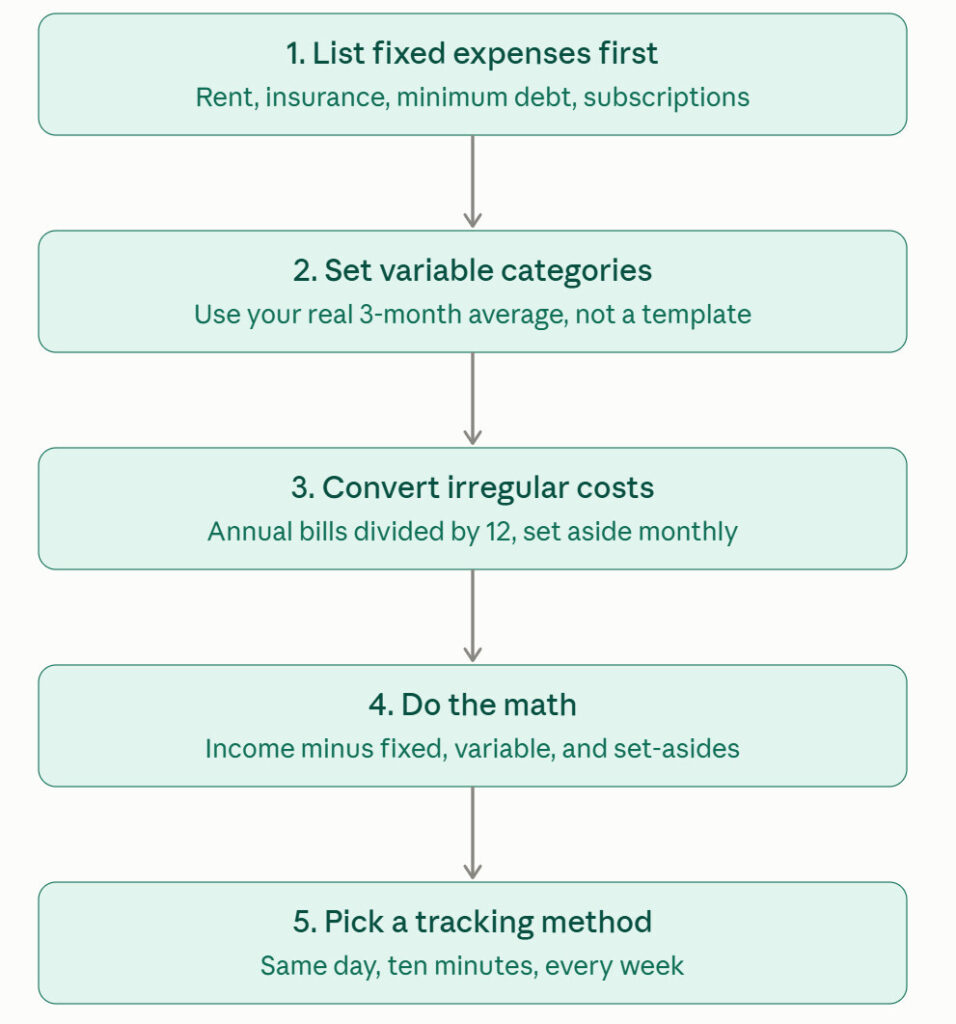
1. List your fixed expenses first
These are the bills that hit whether you’re paying attention or not: rent or mortgage, utilities, insurance, minimum debt payments, phone, internet, subscriptions you’re keeping. Write down the exact amounts — you have the statements open anyway.
Add these up. This is your survival floor. For a lot of people, seeing this single number is already clarifying: it tells you how much of your income is spoken for before you make a single decision.
2. Set variable categories based on your statements, not a template
This is where I’d push back on most budgeting advice. Generic templates hand you categories like “Entertainment: $100” regardless of who you are. But if your statements show you spent $380, $410, and $395 on groceries over the last three months, your grocery budget is not $250 just because you wish it were.
First-month rule: set every variable category at your actual 3-month average. Yes, even the embarrassing ones. Your first budget’s job is not to change your behavior — it’s to accurately describe your behavior. You can’t cut what you haven’t measured honestly.
Keep it to 5–8 variable categories, roughly:
- Groceries
- Dining out / delivery
- Gas or transit
- Personal (haircuts, clothes, small purchases)
- Fun / entertainment
- Household / miscellaneous
Fewer categories means less tracking friction. If a category matters to you specifically — pets, hobbies, kids’ activities — give it its own line. If it doesn’t, fold it into miscellaneous.
3. Convert irregular expenses into monthly amounts
Remember those annual and semi-annual costs from your reality check? Divide each by 12 (or by the number of months until it’s due) and add that as a line item.
Example: $600 car insurance premium due every six months = $100/month set aside. $500 in typical December holiday spending = about $42/month starting in January. Some people call these “sinking funds” — we’ll cover how to organize them in a separate post — but for now, just make sure they exist as lines in your budget. This single step eliminates most of the “surprise” expenses that wreck new budgets.
4. Do the math — and don’t panic at the result
Now the moment of truth:
Net income − fixed expenses − variable categories − irregular monthly set-asides = what’s left
Three outcomes are possible:
You have money left over. Great — assign it a job before the month starts. My suggested priority order for beginners: a starter emergency fund first (even $25–50/month counts), then extra debt payments on your highest-interest balance, then savings goals. Money without an assignment tends to evaporate.
You break roughly even. Also fine. Your first goal is simply to run one month where reality matches the plan. Optimization comes later.
You’re negative. This is more common than budgeting content admits, and it’s not a personal failure — it’s information. You now know the size of the gap, which means you can attack it specifically: which variable category has the most give, which subscription goes, whether the real issue is a fixed cost (housing, car payment) that no amount of latte-skipping will fix. A budget that reveals a $400 monthly shortfall is doing its job. Hiding from that number was the expensive option.
5. Pick a tracking method you’ll actually use
I’ve tried apps, spreadsheets, and pen and paper, and here’s my honest take: the best system is the one with the least friction for you personally. For me, a plain spreadsheet I update every Sunday for ten minutes has outlasted every app I’ve downloaded. Some people love automated apps; others find that automation lets them stop paying attention, which defeats the purpose. A weekly manual check-in — even a rough one — keeps you connected to the numbers in a way passive syncing doesn’t.
Whatever you choose, the cadence matters more than the tool. Once a week, ten minutes, same day every week.
Why Do Most First Budgets Fail? (And How to Make Sure Yours Doesn’t)
Having watched my own budgets fail and restart a few times, the failure patterns are surprisingly consistent:
Failure #1: Budgeting aspirationally. Setting your dining-out budget at $75 when you’ve spent $300/month for a year isn’t a budget, it’s a New Year’s resolution wearing a spreadsheet. Cut gradually — 10–15% per month — and the change actually sticks.
Failure #2: No buffer line. Add a “miscellaneous” category of $50–100 for the stuff you genuinely can’t predict. A budget with zero slack shatters on first contact with reality; a budget with a small buffer bends.
Failure #3: Treating one bad month as total failure. You will blow a category. Everyone does. The budget isn’t broken when you overspend — it’s broken when you stop looking at it because you overspent. Overspent on dining out? Note it, adjust next month, move on. The people who succeed at budgeting aren’t the ones who never miss; they’re the ones who keep showing up on Sunday.
Failure #4: Forgetting the irregular expenses. Covered above, but worth repeating because it kills more budgets than impulse spending does. December is not an emergency. Your car registration is not an emergency. They’re just bills with long fuses.
What Should Your Budget Look Like After Three Months?
Remember that learning how to build a budget from scratch is an ongoing process of calibration, not a one-time event. Month one is observation: run your honest-numbers budget and see how close reality lands.
Month two is calibration: adjust the categories that were way off. Maybe groceries needed $50 more and entertainment needed $50 less. This isn’t failure — this is literally the process working.
Month three is when you start optimizing: now that your numbers are trustworthy, pick one category to deliberately reduce, and redirect that money toward your emergency fund or debt.
By month three, you’ll also have enough data to decide whether a formal framework fits you. The popular 50/30/20 rule (50% needs, 30% wants, 20% savings) is a decent benchmark to compare against — we break down whether it actually works for different income levels in a separate guide. Zero-based budgeting, where every dollar gets assigned a job, suits people who like structure. But notice the order: framework after data, not before. Frameworks applied to fictional numbers produce fictional budgets.
Frequently Asked Questions
How long does it take to build a budget from scratch?
If you are wondering how to build a budget from scratch, plan for about two hours total for the initial setup: one hour reviewing your past statements, and another hour listing expenses and doing the math.
Do I need a budgeting app to start?
No. A notebook or a free spreadsheet works fine, and starting manually actually has an advantage: you see every number pass through your hands, which builds awareness faster than automated syncing. Once your budget is stable, an app can reduce upkeep — but the app is a convenience, not a requirement.
What if my income changes every month?
Budget on your lowest realistic monthly income from the past six months, and treat anything above that as extra to be assigned after it arrives. This keeps your baseline lifestyle funded by income you can count on, while surplus months accelerate your savings or debt payoff instead of inflating your spending.
How much should I budget for savings as a beginner?
Start with whatever amount you can sustain — even $25 a month builds the habit — and aim to work toward saving at least 10–20% of your income over time. If you’re carrying high-interest debt, a small starter emergency fund (commonly $500–$1,000) usually comes first, followed by aggressive debt payoff, then bigger savings goals.
Is budgeting worth it if I’m living paycheck to paycheck?
Arguably it’s most valuable in exactly this situation. A budget won’t create money that isn’t there, but it will show you the exact size and location of the gap — which turns a vague, stressful feeling of “never enough” into a specific, solvable problem. Many people living paycheck to paycheck discover leaks (subscriptions, fees, forgotten recurring charges) worth $50–150/month within their first statement review.
This article is for informational purposes only and is not financial advice. Everyone’s financial situation is different — consider consulting a qualified financial professional for guidance specific to your circumstances.